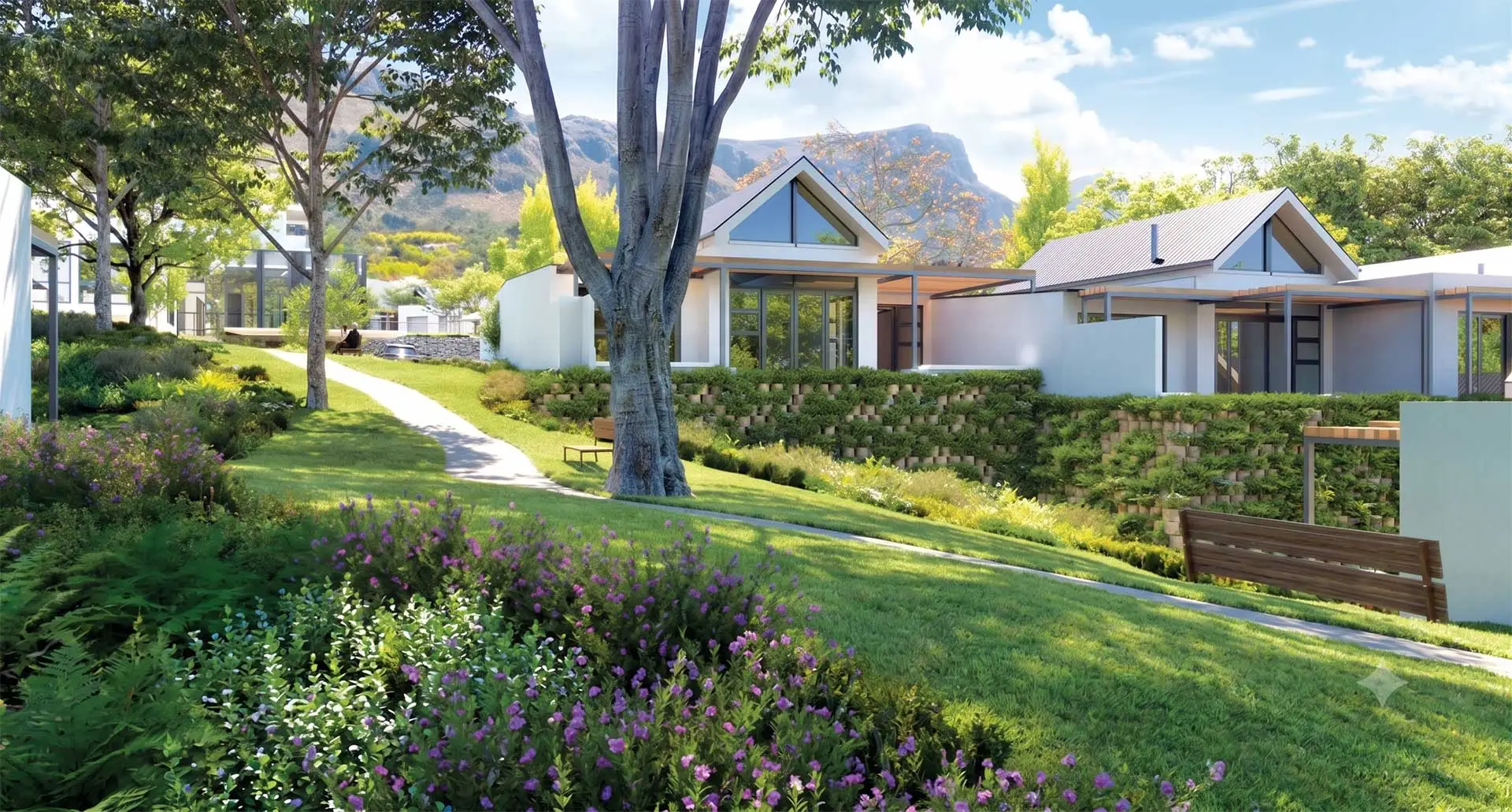
When architects and designers create spaces, they tend to do so from the perspective of their own sensory experience … that is, the perspective of younger or middle-aged professionals with undiminished vision, hearing, touch, and spatial awareness. We have taken a radically different approach: we design as an older person, anticipating how ageing senses will interact with our built environment.
Understanding sensory changes
Ageing brings changes to how we perceive the world. Visual acuity diminishes, colour perception shifts, and contrast sensitivity decreases. Hearing becomes less acute, particularly for higher frequencies. Touch sensitivity changes, and spatial awareness can become less certain.
This raises the question of how our environments can adapt to support continued independence, confidence, and dignity, and it’s where thoughtful design can become transformative.

The strategic use of colour
Colour serves multiple purposes at Great Oaks Retirement Village. We use colour blocking – distinct colour schemes in different areas – to help residents identify and navigate spaces intuitively. Dining areas might feature warmer tones, whilst therapy spaces use calming blues.
We also employ colour to enhance safety. High-contrast edges help residents perceive steps clearly, grab rails in colours that contrast with walls are easier to locate and door frames in distinct hues help residents identify their own units.
Texture and tactile stimulation
Touch becomes an increasingly important sense for orientation and engagement as we age. We deliberately incorporate varied textures, such as smooth wood, woven fabrics, stone, and soft furnishings, to create spaces that invite and reward exploration, and provide sensory richness.
Tactile panels and surfaces serve a dual purpose. They offer sensory stimulation that can be particularly valuable for residents with dementia, providing comfort and engagement. They also function as orientation aids, offering physical cues that complement visual information. A resident might not clearly see the sign indicating the dining room, but they can feel the distinctive texture panel beside the entrance.
Memory boxes: personal landmarks
Each unit at Great Oaks Retirement Village features memory boxes: personalised display cases outside the door where residents can showcase meaningful objects, photographs, or memorabilia. These serve as both practical wayfinding tools and expressions of individual identity.
For someone with diminished vision, recognising their own unit by the distinctive objects displayed there becomes easier than reading a number. For residents with cognitive changes, these personal landmarks provide reassurance and more certain orientation. For all residents, they transform shared spaces into galleries of individual stories.
Mirror screens: preventing distress
Mirrors can become sources of confusion or distress for residents with dementia, who may not recognise their own reflection or may perceive it as another, unknown person in their cottage or apartment. To minimise this we use mirror screens – coverings that can be easily placed over mirrors when needed – to prevent these potentially upsetting experiences whilst preserving the option to use mirrors when appropriate.
This seemingly small intervention reflects our broader philosophy: design should serve the quality of each resident’s experience, adapting to changing needs with dignity and discretion.
Ergonomics for all
Our design considerations extend to the ergonomics that support both residents and caregivers. Handrails are positioned for safety and to facilitate occupational therapy sessions within units. Furniture heights, door widths, and circulation spaces accommodate mobility aids whilst allowing caregivers to comfortably assist.
Lighting receives particular attention. We layer lighting to provide adequate illumination for ageing eyes whilst avoiding glare. Task lighting, ambient lighting, and night lighting work together to create environments that support optimum perception at all hours.
Stimulation through design
Whilst much of our design focuses on safety and orientation, we also recognise the importance of cognitive and sensory stimulation. Visual interest, varied textures, natural patterns, and changing lighting create environments that engage the mind without overwhelming the senses.
This balance between calm and stimulation, or between support and independence defines our approach. We are designing environments where residents can continue to engage with their surroundings confidently, where sensory changes need not diminish quality of life, and where dignity is embedded in every detail.
It is important to us to design as an older person because we understand that truly exceptional care begins with empathy made manifest in the physical environment itself. To learn more, please email info@constantialife.com.